SORVA™
SORVA™
HomeIndividualsAdvisorsEmployersAbout Us
Sign InCreate your plan
Public Beta

Welcome to the Public Beta

Your whole Swiss money life, in one clear plan.

SORVA™ is a Swiss financial planning platform that brings your pensions, savings, taxes, and future spending into one place, so you see a clear, year-by-year picture of your money instead of guessing. Professional-grade Swiss planning, in plain language, that you stay in control of.

Want to see it first? Watch the short demo on sorva.ch: a quick tour of SORVA working on a real plan.

  1. The Public Beta, in short

    SORVA is now open to the public. Anyone living in one of our 12 supported cantons can sign up and start planning, no invitation needed.

    • See it before you sign up. Explore a ready-made, view-only example plan instantly, with no account and no card. It uses sample figures, not your own data.
    • Open, and free. No invitation, no card, no charge right now. In return, we would love your honest feedback.
    • Live in 12 cantons. If your canton is not live yet, you can join the waiting list, and we will tell you the moment it opens.
    • Genuinely useful today. The planning engine, the vault, and the dashboards are all live.
    • Still improving. You may hit rough edges, and screens will keep getting better.
    • It calculates, it does not guess. SORVA runs a deterministic Swiss engine on your own numbers and today's rules. What you see are projections to help you explore your options, not financial or tax advice, and not a promise of any particular outcome.
  2. What you can do

    SORVA is built around the real money questions people in Switzerland ask:

    • When can I retire, and will the money last? SORVA shows three retirement angles in one view: the standard reference age, your earliest retirement age, and your Financial Independence age. Each tested year by year, across your whole life.
    • Pension or lump sum? See both, tax included. SORVA calculates your Pillar 2 as a lifelong pension and as a one-time lump sum, tax included, so you can see which leaves you better off, and mix the two.
    • How do I cut the tax on buy-ins and withdrawals? SORVA shows how pension-fund buy-ins (Einkauf) and staggering your 3a and Pillar 2 withdrawals across years can lower your tax, with illustrative Swiss estimates.
    • How early could I reach financial independence (FIRE)? Set your own financial independence target, in multiples of yearly spending, and SORVA finds the year your liquid wealth reaches it. Tested year by year against the AHV reference age of 65 (transitional ages apply for women born 1961 to 1969) and your earliest retirement age, so you see how much sooner is realistic.
    • Which life goals can I actually afford, and when? Map every big moment in advance: a home, a sabbatical, part-time years, a second property, an early retirement. SORVA tells you which fit, which break the plan, and when.
    • Does the plan work for our whole household? Two careers, two timelines, joint Pillar 2 strategies, shared milestones. Run scenarios where one partner stops working, goes part-time, or retires earlier. SORVA models the household, not just one person.

    Under the hood, SORVA models the Swiss system itself: all three pillars together (AHV, Pillar 2 / BVG, and Pillar 3a), the timing moves that matter (Pillar 2 buy-ins, when to draw each Pillar 3a, bridging the years before AHV if you retire early), and canton-aware taxes for the cantons it supports today (Zurich, Bern, Lucerne, Solothurn, Schwyz, Zug, Basel-Stadt, Basel-Landschaft, Aargau, St. Gallen, Thurgau and Graubünden). It is updated each year as Swiss rules change, and available in English, German, French, and Italian.

    To begin, a guided wizard turns your situation into a plan, quick in minutes or custom for more depth, then opens into a dashboard: net worth, cash flow, payout strategy, a resilience stress test, plain-language insights, and side-by-side scenario compare.

  3. Why SORVA is free right now

    SORVA is independent and bootstrapped, not backed by a bank or venture investors. The best way to build a Swiss planning tool people can trust is to put it in real hands and improve it from real use. So right now, SORVA is free: full access, no card.

    We do plan to charge one day. That is how we stay independent and keep improving without taking commissions or selling your data. This free access is a limited window, not a permanent offer, and it will not stay open forever. When we introduce paid plans, anyone already using SORVA will hear from us well in advance, and no one will be charged automatically.

    In short: joining now, while this window is open, means you help shape SORVA and get full access free.

  4. What we are hoping from you

    SORVA gets better because early users push on it. If you can spare a little time over the next few weeks, two things help us most:

    • Try it with your own situation, then sanity-check the math. Compare SORVA against a recent payslip or tax bill: do the AHV deductions, the income-tax estimate, and the projections look right? If something looks off, tell us. That is exactly what we want to find. (Everything you enter is encrypted and private, so it stays yours.)
    • Share your first impressions. Where did you hesitate? Which views were most useful, and were any confusing? Did anything break? Once you are in, use Contact us in the app so we can track it and reply.
  5. Your privacy, the way it should be

    Your financial life is deeply personal, and we treat it that way. Your data is encrypted and held on servers in Switzerland or the EU/EEA, under the revised Swiss Data Protection Act (FADP). You choose your privacy level: the Standard vault, which you can recover if you forget your password, or the Sovereign vault, encrypted with a key only you hold, so your stored data cannot be decrypted without it. In Sovereign mode, if you lose your recovery key, no one can restore your data. We never sell your data, and we never share your financial data with advertisers or data brokers.

    Security is not a feature we ship once, it is a practice we run continuously. We maintain and harden the infrastructure that protects your data on an ongoing basis, including regular software and dependency updates and configuration hardening, across all vault modes.

  6. Who is behind SORVA

    SORVA is built and operated by Shreevya GmbH, an independent, founder-led Swiss company. It is bootstrapped, not venture-funded, and no bank, broker, or product provider has a stake in us or influence over us. We answer only to the people who use SORVA.

    Shreevya GmbH · Commercial Register (Handelsregister) CHE-429.715.642 · Registered in the Canton of Aargau, Switzerland · contact@sorva.ch

  7. Getting started

    Sign up at sorva.ch, choose your vault, tell SORVA about your situation, and explore your plan. Come back whenever life changes.

    SORVA calculates from your own inputs and current Swiss rules, not guesswork. Rules can change, so for decisions that matter to you, please confirm with a qualified professional, such as a FINMA-regulated financial advisor.

Thank you for being one of our first users. You are not just trying SORVA, you are helping shape it. If something felt off, or is missing, we would genuinely love to hear it.

The SORVA team

What's new

v1.5.1 to v1.5.2Latest·5 October 2026

Improvements

Some of these changes move the numbers in your plan. To see them, open your plan and click Sync plan. If you don't see that button, choose Edit plan, check your entries, and click Update Plan.

Year Summary, Active plan, Pension fund and vested benefits and 6 more

Copy linkLink copiedCopy link
  • Year Summary In a year you live on your savings, Net savings is no longer shown in red, and it appears only once.
  • Active plan Your active plan stays set when you save your profile or create another plan.
  • Pension fund and vested benefits Your plan follows pension-fund savings into a vested benefits account, for example when you stop working before your fund lets you draw them: they are paid out once, when you draw them, and the move itself is not taxed. If your plan includes such a move, it can show much less wealth from your normal pension age, and sometimes a later age to stop working.
  • Mortgage repayment Your plan repays a mortgage you already have in even instalments counted from when you bought the property, with no deadline tied to your age and never more in a year than the largest standard instalment for that property, and repays nothing more once that standard period has passed. Repayments can be smaller, so the mortgage comes down more slowly and you pay more interest. Enter the yearly repayment from your contract and your plan uses it as you enter it; choose No repayment (interest only) for a mortgage you do not repay.
SORVA™Swiss Financial Planning PlatformPublic Beta

Stay in the loop

Opt-in. Unsubscribe anytime with one click.

Product

  • Individuals
  • Advisors
  • Employers

Calculators

  • All calculators
  • FIRE calculator
  • Pillar 3a maximum
  • Annuity or lump sum
  • Pillar 3a retroactive top-up
  • Compound interest

Resources

  • Learn
  • Blogs
  • Release Notes

Company

  • About Us
  • Contact

Important Disclaimer

SORVA provides deterministic mathematical simulations for generic financial and tax planning. The platform does not recommend, broker, or evaluate specific financial instruments, and its outputs do not constitute investment advice or a financial service under the Swiss Financial Services Act (FinSA / FIDLEG). All projections are estimates based on user inputs and current cantonal tax models. They are not legally binding. SORVA assumes no liability for the accuracy of these calculations. Users must consult a certified tax expert or licensed financial advisor before executing legal, tax, or investment decisions.

  • Security
  • Privacy Policy
  • Terms of Service
  • Impressum

© 2026 SORVA (A product of Shreevya GmbH). All rights reserved.

SORVA is a secure web platform, not a mobile app. With detailed charts and information to enter, it works best on a laptop or tablet.

  • Pillar 3a and the mortgage If you repay your mortgage directly, your Pillar 3a is paid out as you planned it, not held for the mortgage until 65. If your Pillar 3a is pledged to your mortgage (indirect amortisation), the part that is not pledged is paid out to you.
  • Lombard loans Your plan includes a Lombard loan (borrowing against your investments): it pays the interest, counts the loan as money you owe and leaves the repayment to you. The age you could stop working takes it into account, so it can come later.
  • Adding a property When you add a property, the suggested mortgage starts from the lending value: the lower of what you paid and what the property is worth today.
  • Two tabs or two devices If SORVA is open in two places, the older one asks you to reload before it saves your profile, so what you saved in the other stays as it is. SORVA also asks before you leave your profile with unsaved changes, and tells you when a new version is available.
  • Also improved The cash flow view, charts, Insights and wording in all four languages.
  • v1.5·27 September 2026

    Your mortgage, the way you actually pay it

    Also in 1.5: enter your salary per month, a simpler pension fund screen, your own names, and more accurate numbers.

    You can now tell your plan how your mortgage is repaid, at home or abroad. SORVA is also easier to fill in, and many calculations are more accurate. What that changes in your figures is listed at the end.

    Copy linkLink copiedCopy link
    1. Your mortgage, the way you actually pay it

      • Swiss mortgage. Enter the yearly repayment from your contract, and one sentence under it says what the plan does with that figure. Leave it empty if you do not know it, and the plan says what it assumes instead.
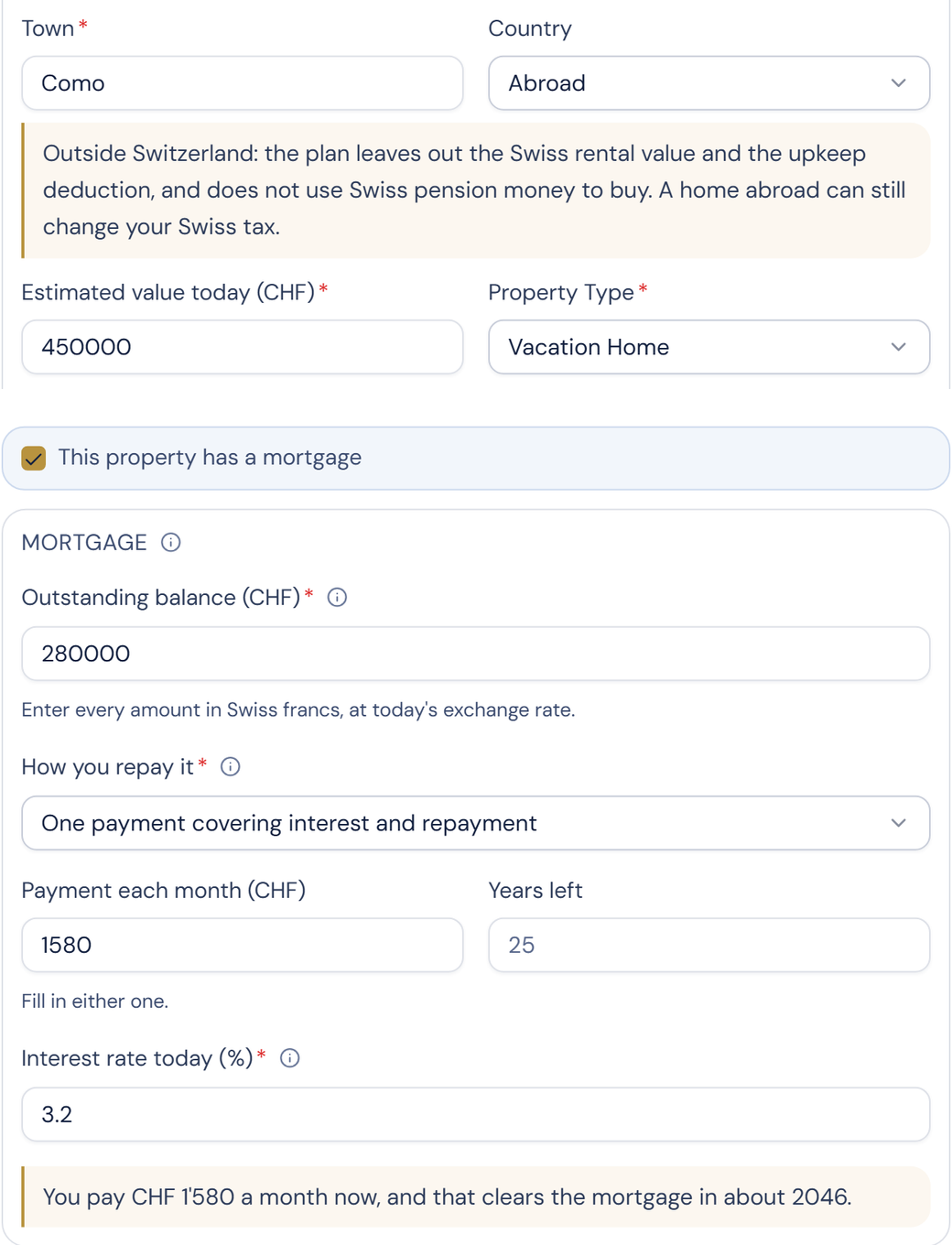
      • A home abroad. A loan on a property outside Switzerland has its own card, with explanations behind info buttons. It asks how the loan is repaid (one payment covering interest and repayment, a fixed amount off plus interest, or interest only), then the payment or the years left, and today's rate.
      The loan card for a home abroad: how the loan is repaid, the payment or the years left, and today's rate.
    2. See where your plan starts

      • Your plan now shows the figures you entered as its starting point, with the date they are from.
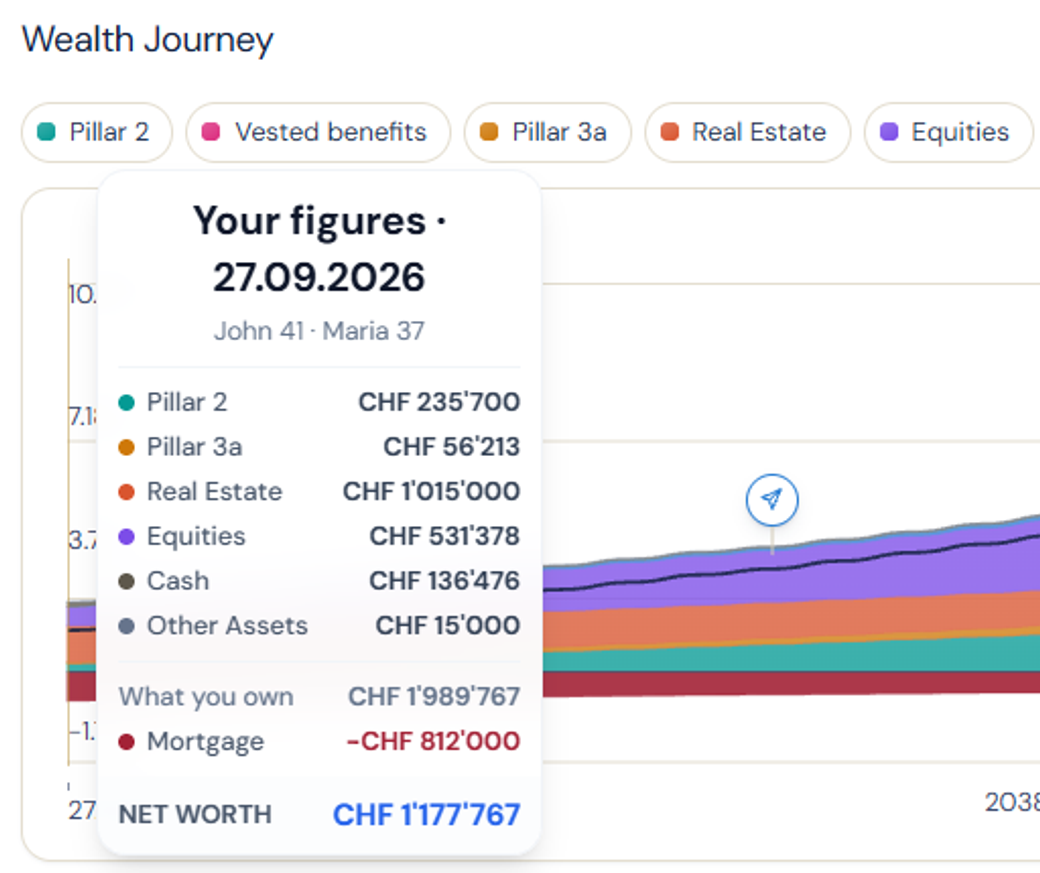
      • The wealth chart opens with those figures in their own column, labelled with the date, and each year after it steps forward from there. The year panel starts there too.
      • Your printed plan shows the date its figures were taken.
      The wealth chart with its first column showing the figures you entered and their date, then each year after it.
    3. Your salary, per month or per year

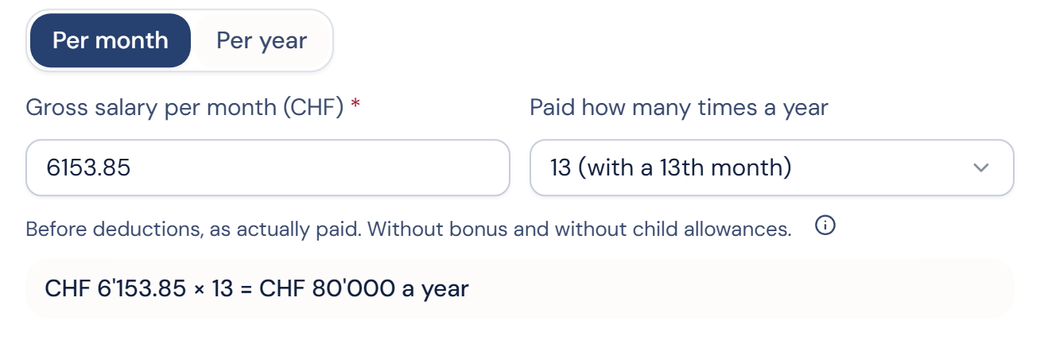
      • A salary now opens on "Per month": your gross monthly salary, and whether it is paid 12, 13 or 14 times a year. SORVA shows the yearly total, for example CHF 7'000 × 13 = CHF 91'000.
      • A line under the salary says what counts: before deductions, as actually paid, without bonus and without child allowances. A worked example sits behind the info icon.
      • The bonus says what it is: not guaranteed, a normal year, never the 13th month.
      • Hourly or irregular pay still goes in "Per year". A salary you saved before shows its monthly figure worked out from the yearly one, and the saved salary does not change unless you edit it.
      The salary window on "Per month": the gross monthly salary, the number of payments a year, and the yearly total.
    4. Your pension fund (Pillar 2), made simpler

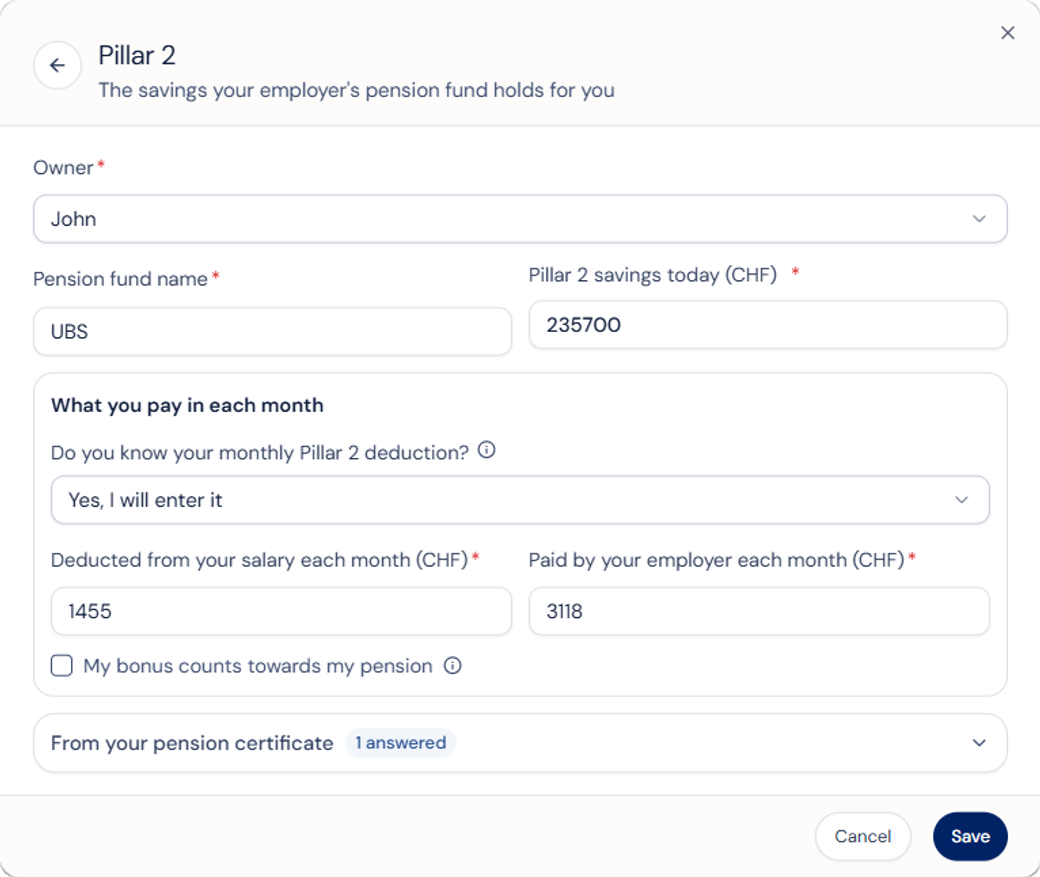
      • The Pillar 2 questions ask for your balance and the pension fund deduction on your monthly payslip first (BVG contribution); the details from your certificate are one tap away, and explanations open with one tap on a phone too.
      • You can say whether you took money out of your pension fund for your own home (early withdrawal for home ownership). If some of it is not yet paid back, the plan schedules no extra voluntary payments into the fund (buy-ins), because the law allows them only once it is paid back in full.
      • A new pension fund entry opens with the name of the job you already described, and your certificate breakdown is still there after a reload.
      The pension fund screen: the balance and the payslip deduction first, the certificate details behind a tap.
    5. Use your own names

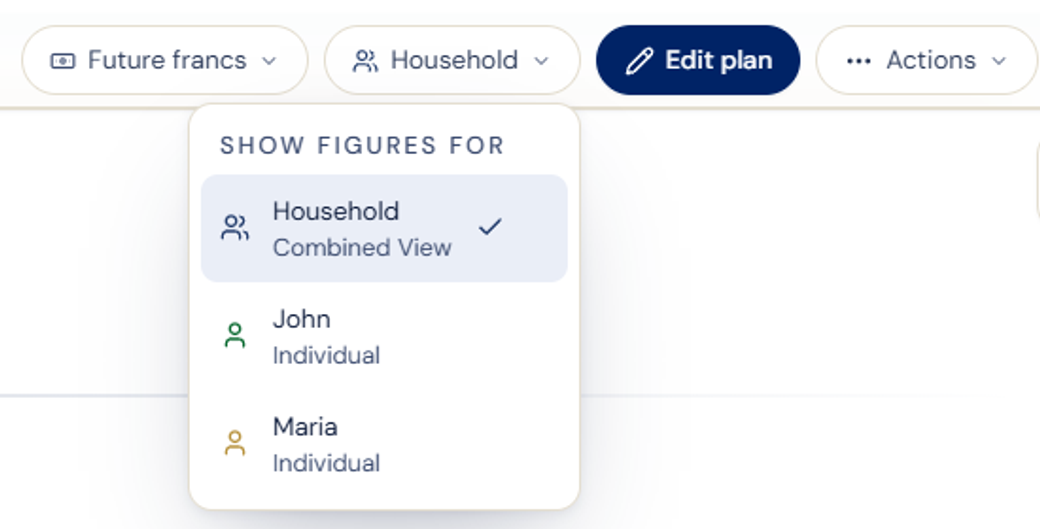
      Give yourself and your partner the names you use. They replace "You" and "Partner" on your dashboard, in the plan builder, in your profile, on the payout screen and in Compare.

      The dashboard showing a couple's own names instead of "You" and "Partner".
    6. Also new

      • Property prices. You can now set how fast property prices grow, and the plan uses your rate.
      • Profile questions. Some questions now use everyday words, for example about years missing from your AHV record, a child still in education, and the rent you receive.
      • Sabbatical and part-time. Pick the year from a list that shows how old you will be.
      • Pillar 3a. "Have you already paid in this year?" is asked only when the answer changes the result.
      • Expenses. The list shows whose cost each one is.
      • Planning horizon. The plan says which ages it allows, and tells you when it changes a number you type. Reopening a plan to edit it no longer resets your horizon to 90.
      • Sharing. Each release note has its own link.
    7. More accurate numbers

      These changes make many calculations more accurate, so some figures in your plan are now different, some higher and some lower. To see them, open your plan and click Sync plan. If you don't see that button, choose Edit plan, check your entries, including your planning horizon, then choose Update Plan.

      • Income in retirement. Rent and other income you receive after you stop working now reach your money.
      • Something you own together. Income from it now counts in full, half for each of you.
      • Tax for couples. Income from something only one of you owns is now worked out from that person's own assets.
      • Savings for couples. A couple's savings are counted once, whether entered for one of you or held together.
      • A home one partner owns alone. Its upkeep is counted once.
      • Buying a property. For a couple, the affordability check now reads both incomes.
      • Investments entered as a total. They now grow at the plan's rate.
      • Pillar 3a pledged to a mortgage. It now counts only what it will certainly hold when the repayment is due (indirect amortisation), so less of the loan may be covered.
      • Shared milestones. A couple's shared milestones in the working years are now paid from the money the partner actually has.
      • Early state pension. If you draw your AHV pension before the normal age, it is now lower until you reach that age, because the years between your claim and the normal age only count from then on.
      • Pension fund balance. If you entered your balance as one figure, without the breakdown from your certificate, the plan now estimates how much of it gets the legal minimum rates (the mandatory part), instead of giving all of it those rates. Figures you type from your certificate are used as typed. A pension from your fund can come out lower as a result.
      • Mortgages. An extra repayment you plan is now paid for in every year it runs. A home abroad no longer follows the Swiss repayment rule; until you fill in its loan card, the plan repays nothing on it.

    Open your plan any time at sorva.ch, and come back whenever life changes.

    SORVA calculates from your own inputs and current Swiss rules, not guesswork. Rules can change, so for decisions that matter to you, please confirm with a qualified professional, such as a FINMA-regulated financial advisor.

    Questions or ideas? Use Contact Us in the app.

    v1.4.1 to v1.4.12·6 to 20 September 2026

    Improvements

    Some of these changes move the numbers in your plan. Open your plan to see the current figures.

    Investment returns, Mortgages, Milestones and 5 more

    Copy linkLink copiedCopy link
    • Investment returns If your private retirement savings (Pillar 3a) are mostly in stocks, your plan now builds when you enter a stock return above 6% a year. The returns you enter now stay when you pick another strategy or reopen your plan, and if a return is higher than the plan can model, you see the limit.
    • Mortgages Your plan now repays your mortgage down to a set level and then stops. If you add repayments of your own, you choose when they stop. The level is measured against the lower of what you paid for the property and what it is worth today. A holiday home or a property you rent out starts from a different level.
    • Milestones A milestone your plan cannot fully cover now appears at its full cost, and your plan shows how much is missing. If you plan as a couple, a milestone you share now costs the same no matter which of you it is listed under.
    • Pension fund Interest on your pension-fund savings (Pillar 2) is now added on your start-of-year balance, which is the timing Swiss pension funds use, and it now works in a year when you or your partner take time off work.
    • Profile details Your private retirement savings (Pillar 3a) and pension-fund details now save without an error, and if your plan cannot be built, you now see the reason.
    • Charts The chart showing how long your money could last is larger, and you can click a single year to keep its figures on screen. The chart of what you own now also shows what you owe.
    • Data export Downloading your data now gives you one file you can open and read. It is not encrypted, so keep it somewhere safe. The Privacy Policy sets out what we store, where it is stored, and what each vault mode means.
    • Language Some wording in German, French and Italian has been corrected to Swiss usage.
    v1.4·11 September 2026

    A redesigned SORVA that stress-tests your plan

    A fresh new look, a plan stress-tested against history, and household planning that now includes couples who live together.

    This is our biggest update yet: a fresh new design across the whole app, a way to stress-test your plan against nearly a century of real market history, household planning that now covers couples who live together and not only married ones, a side-by-side Compare tab, and a clearer view of every decision. As always, SORVA calculates from your own numbers and today's Swiss rules, and what you see are projections to help you explore your options, not financial or tax advice.

    Copy linkLink copiedCopy link
    1. A fresh new look, across the whole app

      We redesigned SORVA end to end: a calmer, cleaner layout, clearer type, and a consistent look from the sign-in screen through every plan tab, your profile, your settings, and the emails we send you. Everything is easier to read at a glance, and your plan takes centre stage.

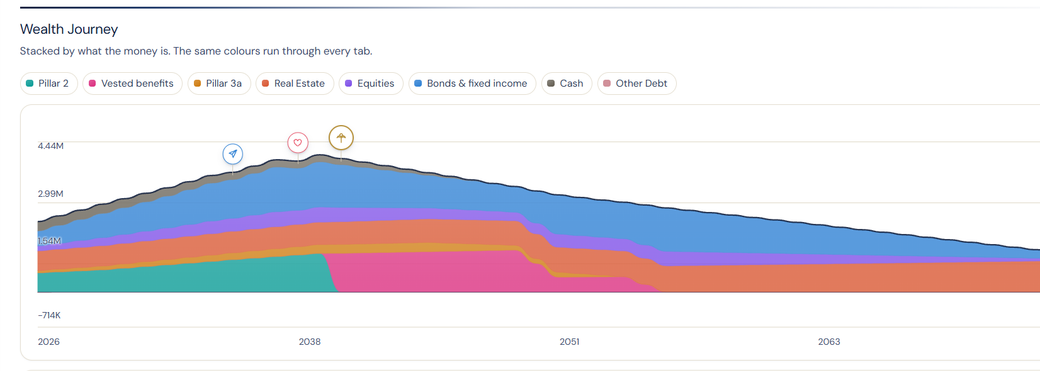
      The wealth chart across a lifetime, stacked by type of money, with markers for the milestones along the way.
    2. Stress-test your plan against real history, and a thousand possible futures

    v1.3·14 August 2026

    SORVA is open in 12 cantons, no invitation needed

    Open to everyone in 12 cantons, free to start, and now open to advisors too.

    SORVA is leaving invitation-only beta. If you live in one of our 12 supported cantons, you can sign up and start planning today, free, with no invitation needed. This release also opens SORVA to advisors for the first time. It adds four more cantons, a free library of Swiss money guides, a more honest resilience view, your own Pillar 2 return in the projection, in-app support, and sharper accuracy across many situations.

    Copy linkLink copiedCopy link
    1. Try SORVA before you sign up

      Curious before you commit? You can now explore SORVA instantly, with no account and no card. Open a ready-made example plan and click through the real dashboards, Overview, Cash Flow, Payout Strategy, Resilience, Insights, and Compare, to see how it works on a full Swiss financial picture. The example is a fixed, view-only sample: it uses sample figures, not your own data. When you are ready, sign up and build your own plan.

    2. Four more cantons: SORVA now covers 12

      We have added Bern, St. Gallen, Thurgau and Graubünden, bringing full canton-aware planning to 12 cantons: Zurich, Bern, Lucerne, Solothurn, Schwyz, Zug, Basel-Stadt, Basel-Landschaft, Aargau, St. Gallen, Thurgau and Graubünden.

      For each, SORVA estimates your income, wealth and capital-withdrawal taxes using that canton's own rules, so your plan reflects where you actually live rather than a national average. More cantons are on the way, and the waiting list is how we prioritise which comes next.

    3. Now open to advisors, too

      Advisors can now use SORVA too. Manage all of your clients in one place, and build each of them a full, year-by-year lifetime plan you can work through together. Whether you work as a financial advisor, financial planner, or pension-planning specialist, independent or part of a firm, you can create a free advisor account and work from a dedicated dashboard:

      • Add and manage your clients
      • Build and update a full lifetime plan for each one
      • Share a plan securely for your client to open and follow
      • Export a polished PDF
      • Keep dated notes
      • Schedule client meetings

      It is free to get started.

    4. Learn the Swiss system as you plan

      We have added a free library of plain-language guides on how Swiss money really works. Sixteen guides, each available in English, German, French and Italian, covering the three-pillar system, Pillar 3a, taking your pension as a lump sum or as income, staggering your capital withdrawals, and more. Read them any time to understand the "why" behind every number you see.

    5. A more honest resilience view

      The Resilience tab used to show a row that stayed reassuringly the same for almost everyone. We replaced it with an honest longevity indicator that shows how much headroom your plan has in your later years, so a comfortable plan and a stretched one no longer look identical. It is a small change that makes the tab tell the truth at a glance.

    6. Your own Pillar 2 return, now reflected in your projection

      If you set an expected return for your occupational pension (Pillar 2 / BVG), SORVA now applies it to your projection, so a more cautious or more optimistic assumption actually changes what you see. The part of your pension savings above the legal minimum (the extra-mandatory portion) is also now credited at its own return rather than being held to the mandatory minimum.

    7. A cleaner start

      Getting going is simpler. Signing up now takes you straight into building your plan instead of a pricing page, and your canton carries over from sign-up so you never enter it twice. Goal markers on the first step also got a cleaner, more professional look.

    8. Talk to us inside SORVA

      A new "My requests" area lets you see every message you have sent us, reopen a past request, and continue the conversation in one place. We also added a Feedback category and a larger message box, because in an open beta your feedback is what shapes the next release.

    9. A refreshed public site, and a new Security page

      A new Security page explains, in plain language, how your data is encrypted and where it is stored. Across the public site, one clear and consistent story now describes what SORVA does and how it protects your data, with a tidier footer and an optional newsletter sign-up.

    10. More accurate projections across more situations

      SORVA's engine keeps getting sharper. This release groups its corrections by who they affect. These are projections based on your inputs, not financial advice.

      Changes that affect most plans

      Years without employment: If your plan includes years without paid work, such as a career break or an early retirement, your AHV contributions in those years now count toward your contribution record and help avoid a gap that would otherwise reduce your pension, and the reduction for drawing your AHV early now applies as the law intends.

      No invented numbers: Where an input is left empty, SORVA now treats it as empty rather than quietly filling it with an assumed figure. Projections no longer include growth or income that you did not enter.

      Changes for couples

      Both partners retired early: For couples where both partners have stepped back from paid work, each partner's AHV contribution is now charged correctly, and a household-level double count has been removed.

      Changes for specific cantons

      Capital-withdrawal tax: The estimate now matches the official rate schedules more closely in Zurich and Aargau, and the rate tables for Bern and Graubünden were extended against the current official cantonal rate schedules.

    11. Clearer choices for your retirement age

      Step 1 used to offer three options side by side, but they were never really three: picking an age yourself answers a different question from letting SORVA work one out. You now choose between Pick an age and Financial independence age. Choose the second and you say how it should be worked out: Auto calculated replays your whole plan year by year and finds the earliest age it still holds up, or My own rule uses a multiple of your annual spending that you set yourself. Every option now carries a plain-language explanation.

      And when you keep the calculated age as a comparison rather than as your stop-work age, it now appears right beside your retirement age on the dashboard, whichever method you chose. Previously that happened for only one of the two.

    Sign up at sorva.ch, choose your vault, tell SORVA about your situation, and explore your plan. Come back whenever life changes.

    SORVA calculates from your own inputs and current Swiss rules, not guesswork. Rules can change, so for decisions that matter to you, please confirm with a qualified professional, such as a FINMA-regulated financial advisor.

    v1.2·31 July 2026

    Every number in your plan, now explained

    Savings broken down by pillar, sharper projections, and accuracy fixes across a wide range of household types.

    This release makes more of what your plan is calculating visible and readable: where savings are going, how pension money moves, and what drives each projected opportunity. It also includes our most comprehensive set of accuracy improvements to date, covering a wide range of household types and cantons. As always, SORVA calculates from your own numbers and today's Swiss rules: these are projections to help you explore your options, not financial or tax advice.

    Copy linkLink copiedCopy link
    1. Know whether growth or tax savings drives your opportunity

      The Insights tab shows you personalised insights based on your plan, for example, what the projected effect might be if you increased your Pillar 3a contributions, adjusted your investment allocation, or coordinated pension payout timing. These are projections based on your inputs, not financial advice.

      Each opportunity in Potential Opportunities now shows you two numbers: how much of the projected benefit may come from your money growing over time, and how much may come from reducing the tax you pay along the way.

      Investment growth depends on markets and is never guaranteed; tax savings follow defined rules and do not. Seeing that split in one place changes how you weigh an opportunity, not just whether to act, but which type of benefit you are actually relying on.

    2. See exactly what you're saving, broken down

      Most retirement tools show you a number at the end: what you might have when you stop working. SORVA now also shows you what you are actively building right now, in a new Savings breakdown on your plan dashboard.

      It splits your monthly household savings into what is going into your private pension account (Pillar 3a in Switzerland's three-pillar retirement system), your investment and cash accounts, and your mortgage repayments. That last one is easy to overlook: every franc you pay down on a mortgage builds equity in your property. SORVA now models it that way, alongside your other savings. The total on your dashboard and the detail behind it always tell the same story.

    3. See every pension transfer on your timeline

      Switzerland's pension system moves your money between different layers at key moments: your state pension (AHV/AVS), your occupational pension through employers (Pillar 2), and your private retirement savings (Pillar 3a).

      SORVA's Cash Flow tab now shows those transfers as visible, named events. When your occupational pension moves to a vested-benefits account (Freizügigkeitskonto) between jobs or before retirement, you will see that transfer. When you draw down your private pension savings and pay the one-time withdrawal tax on it, that appears as its own line, the same way occupational pension payouts already did. Nothing is buried inside a total anymore.

      Any property you add to your plan can now carry a name you choose. That name stays with it through your Cash Flow view, your wealth chart, and your plan summaries, so you always know which property is which.

    4. Compare pension payouts for each partner, with separate return assumptions

      Previously your pension payout details were only visible at the household level. In the Payout Strategy tab, you can now switch between your view and your partner's view to see how each person's pension is projected to be paid out, and set investment return assumptions independently for each person.

    5. Understand what your plan is spending, by category

      Your plan's first-year spending is now broken down by category on your dashboard, not just shown as a single total. You can see what each category contributes, and how that compares to what you spend today. If the difference is meaningful, it is called out directly.

    6. Set your financial independence (FIRE) target in plain language

      If you are planning for Financial Independence, Retire Early (FIRE), meaning you want to reach financial independence before the standard retirement age, SORVA's Goals step now lets you express your target as a plain sentence, reading back what you want rather than presenting a grid of fields. The numbers are still yours to adjust; they just sit in a format that is easier to read and reason about.

    7. More transparency, right where you need it

      What is counted in your Total Net Wealth

      The Total Net Wealth tile on your Overview now has a tooltip that explains exactly which assets and liabilities are included in that number, and, if you are planning for financial independence, whether the figure is measured before or after your target.

      The assumptions behind your projection

      Return and inflation rates, the numbers that drive everything else, are now shown directly in your plan setup and on your dashboard. A tooltip on your occupational pension (Pillar 2) projection shows which assumptions apply.

      Explanations next to every input

      SORVA now surfaces short explanations directly next to inputs in Wealth Accumulation and in the Pension Withdrawal step. No jargon, no separate help article: the context is where you are when you need it.

    8. More accurate projections across a wide range of situations

      Changes affecting most plans

      Families with children: The number of children you enter in your profile was not reaching the tax calculation correctly. This affected child tax relief across all supported cantons, and is now fixed.

      Child relief age bands: The age ranges for child tax relief now match the official bands set by Swiss tax law, both for federal direct tax and in each supported canton.

      Your living expenses: If you had entered a custom annual expense amount, a bug in the Basic Living field could overwrite it. This is now resolved.

      Private investment yield: If you hold private investments with a specified annual yield rate, that yield was being included in your taxable income twice in some configurations. This is now corrected.

      Church tax: Church tax in Switzerland is determined by local church communities (Kirchgemeinden), whose rates can vary below the cantonal level. This is now corrected across all supported cantons.

      Debt interest: Interest on your liabilities, including mortgages and loans, is now counted as a real cost in your Net Savings figure.

      Income sources: Your income summary is now filtered to sources that apply to your specific situation.

      Changes for couples

      Pillar 3a and investment returns: The Savings tab now correctly sums both partners' Pillar 3a contributions. Joint investment portfolios are now correctly split across each person's projection.

      Shared home sale: If you and your partner plan to sell a jointly owned property as part of a relocation in your plan, both partners' shares of the sale proceeds are now correctly credited.

      Health insurance: The assumed health insurance (KVG) premium is now calculated for both spouses, not just one.

    9. Built to a higher security standard

      Security is not a feature we ship once; it is a practice we run continuously. This release includes the results of a full infrastructure security review: we updated the software the app is built on, tightened our server security configuration, and strengthened several backend layers. The infrastructure protecting your data is subject to the same ongoing review and hardening across all vault modes.

    SORVA is still free during the Private Beta, and still built to calculate from your own inputs, not to guess. Thank you for helping us shape SORVA. If something feels off or is missing, tell us through Contact us in the application.

    The SORVA team

    v1.1·18 July 2026

    Four new cantons: Lucerne, Solothurn, Schwyz and Zug

    Your whole Swiss money life, in one clear plan.

    Since we opened the Private Beta, our biggest step is this: SORVA now models four more cantons: Lucerne, Solothurn, Schwyz and Zug, so your plan reflects each canton's and commune's own rules. Alongside that, we have improved views across the application. As always, SORVA calculates from your own numbers and today's Swiss rules: these are projections to help you explore your options, not financial or tax advice.

    Copy linkLink copiedCopy link
    1. New: Lucerne, Solothurn, Schwyz and Zug

      SORVA now models Lucerne, Solothurn, Schwyz and Zug in full cantonal and communal detail, joining Zurich, Basel-Stadt, Basel-Landschaft and Aargau for eight cantons in total. For each, we model the details that actually move your projection: cantonal and communal income and wealth tax, wealth-tax allowances, the personal tax (Personalsteuer) where a canton levies one, and church tax calculated for your specific commune. If you live in one of these cantons, you can now build a plan calibrated to where you actually live.

    2. A clearer Payout Strategy view

      Lump sum or monthly pension is one of the biggest retirement choices, so we rebuilt this view to be easier to read. You now see the key number up front and can open each pillar (AHV, Pillar 2, Pillar 3a) to see when each payout happens and its estimated tax under today's rules. If you used part of your Pillar 2 for your home, that advance is now shown too.

    3. A more interactive net-worth overview

      Your net-worth overview is now more interactive. Click any year on the wealth chart to see that year's full summary, and the equity and bonds split now stays visible on every year that holds securities. It is easier to explore how your wealth develops, year by year.

    4. Sharper, more honest insights

      Your personalised insights read more clearly, and the pension-versus-lump-sum explanation is easier to follow. We also refined the modelling so a partner with no earned income is no longer shown a Pillar 3a, in line with the Swiss rule that Pillar 3a requires earned income. And when you compare strategies side by side, each one is now priced more precisely.

    5. A smoother start

      First-time setup is gentler: SORVA now guides you to finish your profile before showing your plan, and marks required fields more clearly.

    6. Get to know the people behind SORVA

      You should know who is building the tool you trust with your financial life. We have added an About page with our company and founder details, so SORVA is no longer anonymous. We have also started sharing our journey publicly, come follow along and say hello: LinkedIn, X, YouTube, Facebook, and Instagram. You will find these in the site footer too.

    7. New ways to keep up, all opt-in

      There is now a "What's New" page and a small note in the application when we ship something. If you would like occasional Swiss financial-planning, pension and tax insights by email, you can opt in from Settings (double opt-in, and you can leave any time). Nothing is turned on without your say-so.

    8. Better German, French and Italian

      We did a thorough language pass across the whole application so the German, French and Italian read naturally, with correct Swiss financial terminology.

    SORVA is still free during the Private Beta, and still built to calculate from your own inputs, not to guess. Thank you for helping us shape SORVA. If something feels off or is missing, tell us through Contact us in the application.

    The SORVA team

    v1.0·7 July 2026

    Welcome to the SORVA Private Beta

    Your whole Swiss money life, in one clear plan.

    SORVA™ is a Swiss financial planning platform that brings your pensions, savings, taxes, and future spending into one place, so you see a clear, year-by-year picture of your money instead of guessing. Professional-grade Swiss planning, in plain language, that you stay in control of.

    Want to see it first? Watch the short demo on sorva.ch: a quick tour of SORVA working on a real plan.

    Copy linkLink copiedCopy link
    1. The Private Beta, in short

      We are opening SORVA to a limited group of early users, by invitation, in small cohorts.

      • Invitation only, and free. No card, no charge. In return, we ask for your honest feedback.
      • Genuinely useful today. The planning engine, the vault, and the dashboards are all live.
      • Still being polished. You may hit rough edges, and screens will keep improving.
      • It calculates, it does not guess. SORVA runs a deterministic Swiss engine on your own numbers and today's rules. What you see are projections to help you explore your options, not financial or tax advice, and not a promise of any particular outcome.

      How to get in: Request access on sorva.ch. It takes a minute. We review requests against the places in the current cohort, and if you are approved you receive a personal invitation code to sign up. If not this round, you stay on the list for the next.

    2. What you can do

      SORVA is built around the real money questions people in Switzerland ask:

      • When can I retire, and will the plan hold? See three angles side by side: the standard reference age, the earliest realistic age your plan still supports, and your Financial Independence (FIRE) age, each tested year by year.
      • What if I retire at a different age? Pick any age, earlier, later, or phased, and see what changes.
      • Lump sum or monthly pension? Compare taking your pension fund as capital, as a pension, or a mix, with the estimated tax impact alongside.
      • Which life goals can I afford, and when? A home, a sabbatical, part-time years: see which fit and which strain the plan.
      • Does it work for our whole household? Two careers, two timelines, shared goals. SORVA models the household, not just one person.

      Under the hood, SORVA models the Swiss system itself: all three pillars together (AHV, Pillar 2 / BVG, and Pillar 3a), the timing moves that matter (Pillar 2 buy-ins, when to draw each Pillar 3a, bridging the years before AHV if you retire early), and canton-aware taxes for the cantons it supports today (Zurich, Basel-Stadt, Basel-Landschaft, Aargau, Lucerne, Solothurn, Schwyz and Zug). It is updated each year as Swiss rules change, and available in English, German, French, and Italian.

      To begin, a guided wizard turns your situation into a plan, quick in minutes or custom for more depth, then opens into a dashboard: net worth, cash flow, payout strategy, a resilience stress test, plain-language insights, and side-by-side scenario compare.

      SORVA is a secure web platform, not a mobile app. With detailed charts and information to enter, it works best on a laptop or tablet.

    3. What we are hoping from you

      SORVA gets better because early users push on it. If you can spare a little time over the next few weeks, two things help us most:

      • Try it with your own situation, then sanity-check the math. Compare SORVA against a recent payslip or tax bill: do the AHV deductions, the income-tax estimate, and the projections look right? If something looks off, tell us. That is exactly what we want to find. (Everything you enter is encrypted and private, so it stays yours.)
      • Share your first impressions. Where did you hesitate? Which views were most useful, and were any confusing? Did anything break? Once you are in, use Contact us in the app so we can track it and reply.
    4. Your privacy

      Your financial life is deeply personal, and we treat it that way.

      • Your data is encrypted and stored in Switzerland, under Swiss data protection law (the revised FADP).
      • You choose your privacy level: the Standard vault, which you can recover if you forget your password, or the Sovereign vault, locked with a key only you hold, where not even we can open it. In Sovereign mode, if you lose your recovery key, no one can restore your data.
      • We never sell your data, and never share it with advertisers or data brokers. See our full commitments.
    5. How we make money

      SORVA is free during the Private Beta. We have not yet decided how it will be priced later, whether a subscription, a one-time fee, or something else, and we will announce it well before it applies. What we will never do is take commissions or sell your data.

    6. Who is behind SORVA

      SORVA is built and operated by Shreevya GmbH, an independent, founder-led Swiss company. It is bootstrapped, not venture-funded, and no bank, broker, or product provider has a stake in us or influence over us. We answer only to the people who use SORVA.

      Shreevya GmbH · Commercial Register (Handelsregister) CHE-429.715.642 · Registered in the Canton of Aargau, Switzerland · contact@sorva.ch

    7. Getting started

      Request access, and once approved, sign up with your invitation code, choose your vault, tell SORVA about your situation, and explore your plan. Come back whenever life changes.

      SORVA calculates from your own inputs and current Swiss rules, not guesswork. Rules can change, so for decisions that matter to you, please confirm with a qualified professional, such as a FINMA-regulated financial advisor.

    Thank you for being one of our first users. You are not just trying SORVA, you are helping shape it. If something felt off, or is missing, we would genuinely love to hear it.

    The SORVA team

  • Milestones. A milestone is priced in the francs of the year it happens, so one years away costs more than before, and a plan may show it as less well covered.
  • Inflation. Plans now open with inflation included, so later years look larger; only the way they are shown changed. You can switch to today's francs, without inflation, at the top of your plan.
  • Plans that run short. The share of past market histories in which your money lasts no longer counts a year the plan cannot pay as a good one.
  • Compare. The vested benefits row shows the balance on the day you retire.
  • A plan that only works in an average decade is not really a plan. SORVA now puts yours through the kind of stress test professionals use, and shows the result in plain language.

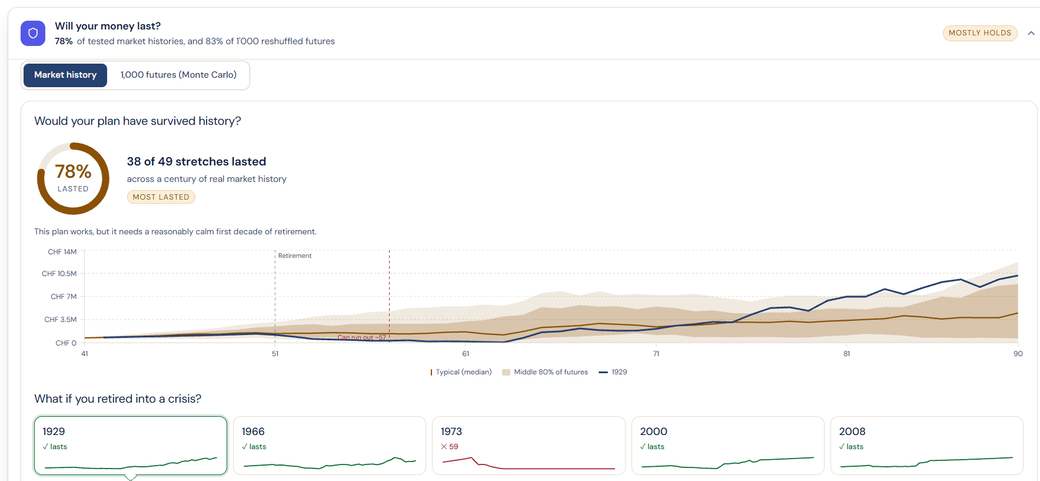
    • Nearly a century of real Swiss-franc history. SORVA replays your plan through every start year since 1928, in Swiss francs, with your pension income eroded by Swiss inflation rather than foreign prices. You can see how your plan would have held up if you had retired into a downturn like 1929, 1966, 1973, 2000 or 2008.
    • A thousand possible futures. SORVA reshuffles real market history into 1,000 what-if futures and shows you the share in which your money lasts, plus a chart of where your wealth could land across the years.
    • Flip on a shock and watch your own curve bend. Switch on a market crash and a jump in the cost of living, together if you like, and see the effect on your plan straight away.
    • Conservative by design. When two views disagree, SORVA shows you the tougher one, and it does not round a survival result up to look better than it is.

    These are illustrations of how your plan might behave, not a promise of any outcome.

    The stress test opened up: the share of market histories in which the money lasted, the spread of outcomes over the years, and a row of past crises showing whether the plan survived each one.
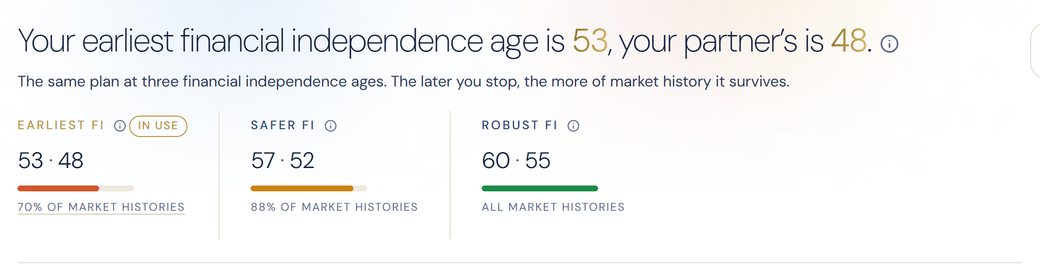
  • Three financial independence ages, not one

    SORVA already showed you your financial independence age. Now it shows three, and lets you choose between them.

    • Earliest, safer, robust. Each age carries the share of real market history in which the money lasted, so you can see what every extra year of work actually buys you.
    • Pick one and the plan follows. Click an age and it becomes the age your plan uses, recalculated from end to end.
    • Worked out from your own numbers. SORVA replays your whole plan year by year, with AHV, your pension fund, Pillar 3a, taxes and spending, rather than applying a rule of thumb.

    The later you stop, the more of market history your plan survives. These are modelled outcomes, not a promise.

    The three financial independence ages side by side, each with the share of market history in which the money lasted, and the one currently in use marked.
  • Now for couples who live together, not only married ones

    SORVA already planned married couples and registered partnerships as one household. Now it does the same for couples who live together without being married.

    • Both partners, planned together. Your partner gets a full lane of their own, their own career, savings and pensions, and each of you can retire at a different age.
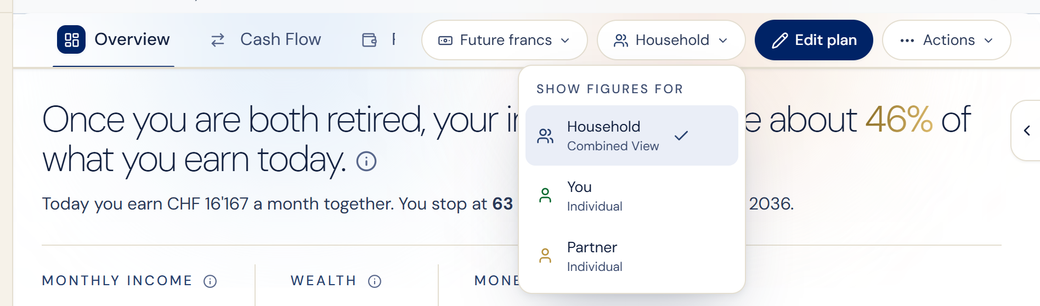
    • See each person, and the whole household. Switch between your view, your partner's view, and the combined picture, with each pension shown for each person.
    • Planned the way Switzerland treats you. Married or in a registered partnership, you are planned as a jointly assessed household, and SORVA splits your AHV income across your years of marriage, the way the AHV does. Living together without being married, each of you is planned as an individual, because that is how you are taxed and how your AHV is credited. Couple tax figures are projections from today's rules, not tax advice.
    • One shared plan. Run scenarios where one of you goes part-time or stops earlier, and see whether the household still holds, including the years one of you may need to bridge before a pension starts.
    The SORVA household view, with tabs for you, your partner, and the two of you combined.
  • Built for more than one job at a time

    Many people in Switzerland hold more than one job at once, and that changes how their pension builds up. SORVA now plans it properly.

    • Add more than one job. Enter up to three concurrent jobs per person, each with its own salary, bonus, workload and pension fund, and SORVA plans them together.
    • Each job's Pillar 2, worked out on its own. SORVA applies the occupational-pension entry threshold and coordination deduction to each employer separately, the way Swiss law does, so two jobs build up pension realistically instead of one over-optimistic number.
    • Several pension pots, drawn on their own timing. At retirement, SORVA can stagger the payout of your separate pension-fund and vested-benefits accounts across years, which can help keep the tax down.
    • AHV across all your jobs. Your AHV is worked out across your combined earnings.
  • Compare your options side by side

    A new Compare tab lets you line up your plan against alternatives, a safer strategy, a more growth-focused one, or the status quo, up to five at once, with one chart overlaying every path and a table of the numbers that actually differ. Add an option whenever you want to weigh a decision.

  • Clearer at every step

    • Overview leads with your income gap in plain words, lets you highlight more than one type of saving on the wealth chart at once, and shows a resilience score you can open for the full picture.
    • Cash Flow walks your money year by year, with your milestones and the moments each pension starts, laid out as a journey.
    • Insights groups household suggestions where they belong, and adds a simple To do / By phase toggle.
  • A smoother start

    Signing up now takes you straight into your plan. We greet you once, then ask the one thing you most want to know, "Can I retire at 65?" or "What is my financial independence age?", and go from there. Step away and come back, and you pick up exactly where you left off.

  • Open your plan any time at sorva.ch, and come back whenever life changes.

    SORVA calculates from your own inputs and current Swiss rules, not guesswork. Rules can change, so for decisions that matter to you, please confirm with a qualified professional, such as a FINMA-regulated financial advisor.

    AHV for married couples: The income-splitting calculation (Einkommensteilung), which combines and divides equally the income earned by both spouses during their years of marriage, now correctly responds to your year of marriage.

    Changes for specific cantons

    Owner-occupied homes: A primary residence was incorrectly generating additional taxable rental income. That duplicate amount has been removed. The notional rental value (Eigenmietwert) that Swiss tax law requires for owner-occupied homes continues to be correctly included in your projection.

    Canton Zug (ZG): Capital-withdrawal tax in the lower income bands now matches the official rate schedule.

    Canton Schwyz (SZ): The cantonal retirement deduction (Alters-/Rentnerabzug) and the health insurance premium deduction are now correctly applied.

    Cantons AG, LU, SO, SZ, ZG: Cantonal social deductions now reflect the correct statutory values.